Commercial Roofing in Garland, TX: Big Industrial Roofs, Handled Right

Commercial Roofing in Garland, TX: Big Industrial Roofs, Handled Right

Garland built its reputation on making things. Decades of manufacturing, warehousing, and distribution have left the city with an enormous inventory of large-footprint industrial buildings, many of them topped by roofs that measure in the hundreds of thousands of square feet and count their age in decades. Those roofs are a different animal from a strip-mall cover. A problem on one of them can shut down a production line, soak a warehouse of inventory, or idle a loading dock, and the repair involves acres of membrane rather than a patch. That scale is what makes commercial roofing in Garland its own kind of work, and it rewards a contractor who understands big, aging roofs instead of treating every job like a small one.

SCR, Inc. General Contractors handles that scale across the eastern Metroplex, dispatching to Garland from its Terrell headquarters and Rockwall branch. The company's reach runs the full span of commercial roofing, but on a Garland industrial building the decisions that matter most tend to cluster around size, age, and the cost of an interruption. Those are worth walking through plainly.

A Few Cents Per Foot Can Decide a Six-Figure Roof

On a large Garland industrial roof, choices measured in a dollar or two per square foot multiply into enormous sums across hundreds of thousands of feet. That is why system selection and an accurate roof measurement matter more on big buildings than almost any other factor.

Wet Insulation Hides Under an Intact-Looking Roof

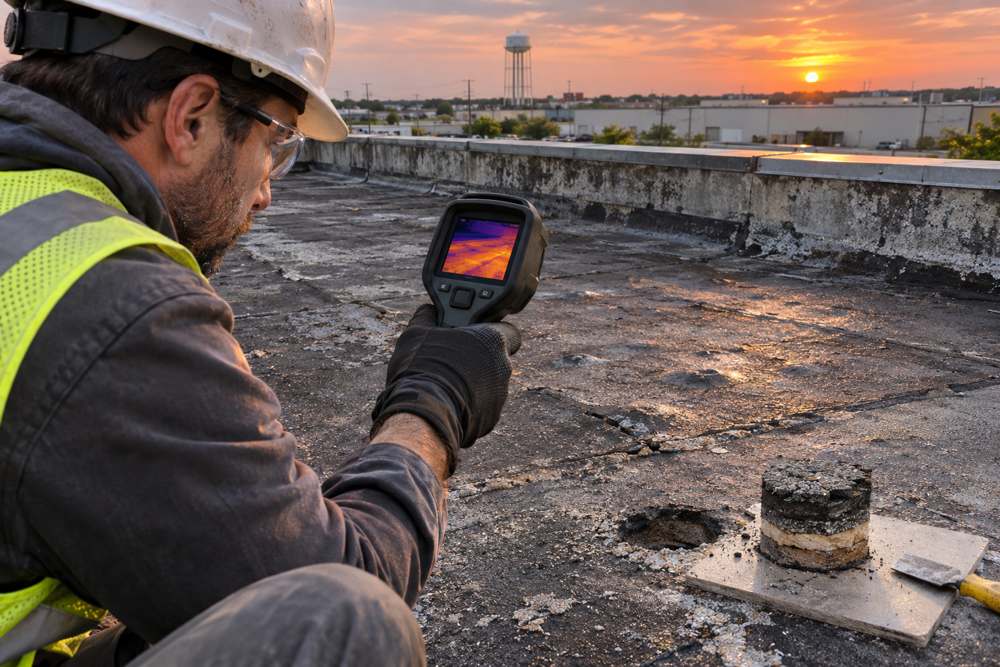
Water that enters an aging membrane spreads sideways through the insulation and can soak large areas while the surface still looks fine from above. An infrared survey reveals that hidden moisture by its temperature, which is the only dependable way to judge a big roof’s true condition.

Texas HB3 Draws the Lines on Storm Claims

Texas House Bill 3 established specific boundaries for how roofing contractors and insurers may deal with each other on storm-damage claims. For a large industrial loss, working with a locally licensed contractor who respects those boundaries is safer than relying on a crew that only appears after a storm.


Social Media & Citations

Large Roofs Turn Small Numbers Into Big Ones

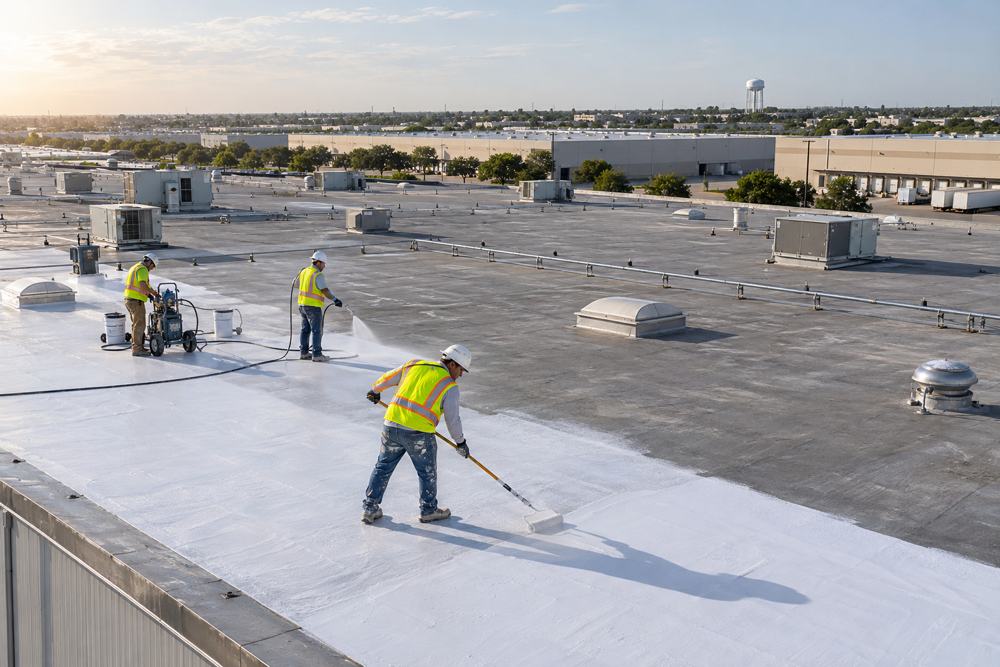
On a sprawling industrial roof, a figure that sounds minor on paper becomes a major capital question. A dollar or two per square foot of difference between roofing systems, trivial on a 3,000 square foot office, swings into six figures across a 150,000 square foot plant. That math changes how an owner should approach the roof. A full tear-off and replacement on a building that size is a large, scheduled project, often phased across sections so operations keep running, and the system chosen shapes both the price and the next twenty-five years. Where the deck and structure are sound, a restoration coating over the existing roof can deliver another ten to fifteen years for a fraction of replacement, which on a huge roof represents real preserved capital. Getting the scale economics right is central to smart commercial roofing in Garland, and it starts with knowing what each option costs per square foot before multiplying by a very large number.

What an Aging Garland Roof Hides

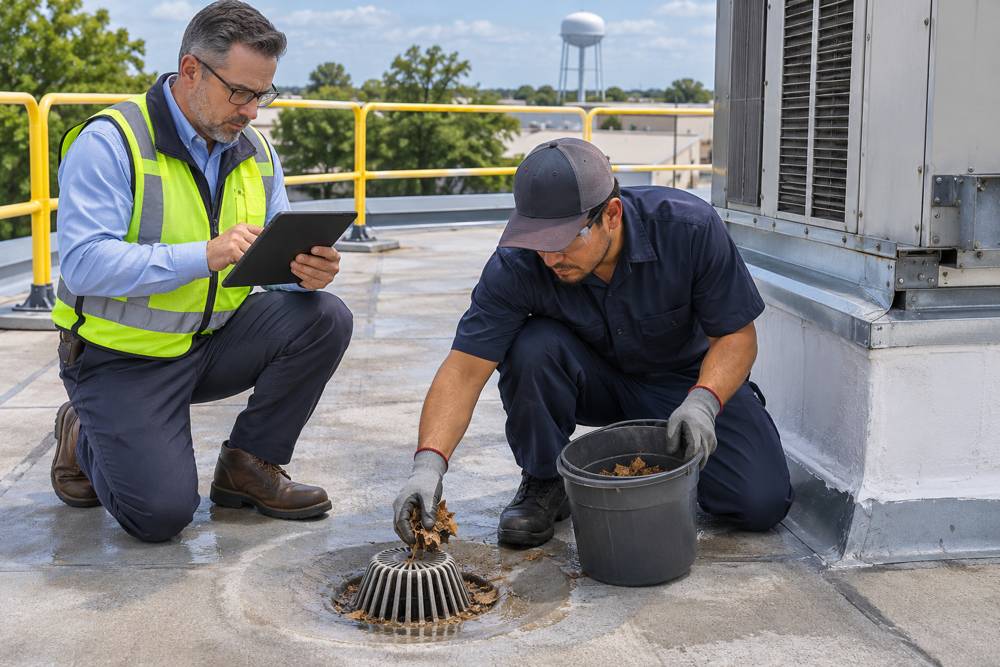
Much of Garland's industrial stock wears older built-up and modified bitumen roofs, the layered asphalt systems that were standard when these plants went up. As those roofs pass twenty years, they crack, blister, and lose their surfacing, and water begins to creep into the insulation where it cannot be seen from a walk across the surface. On a roof this large, that saturation can spread across whole bays before a single ceiling tile stains. The only reliable way to find it is an infrared moisture survey, which reads the temperature of wet insulation through an intact membrane, backed by core cuts that show the actual condition of each layer. That survey tells an owner whether a roof can still be coated and saved or has reached the point where replacement is the honest answer. Skipping it, and quoting a giant roof by eye, is how owners end up paying for the wrong solution. Diagnosis at this scale is the backbone of trustworthy commercial roofing in Garland.

Hail Adds Insult to Age

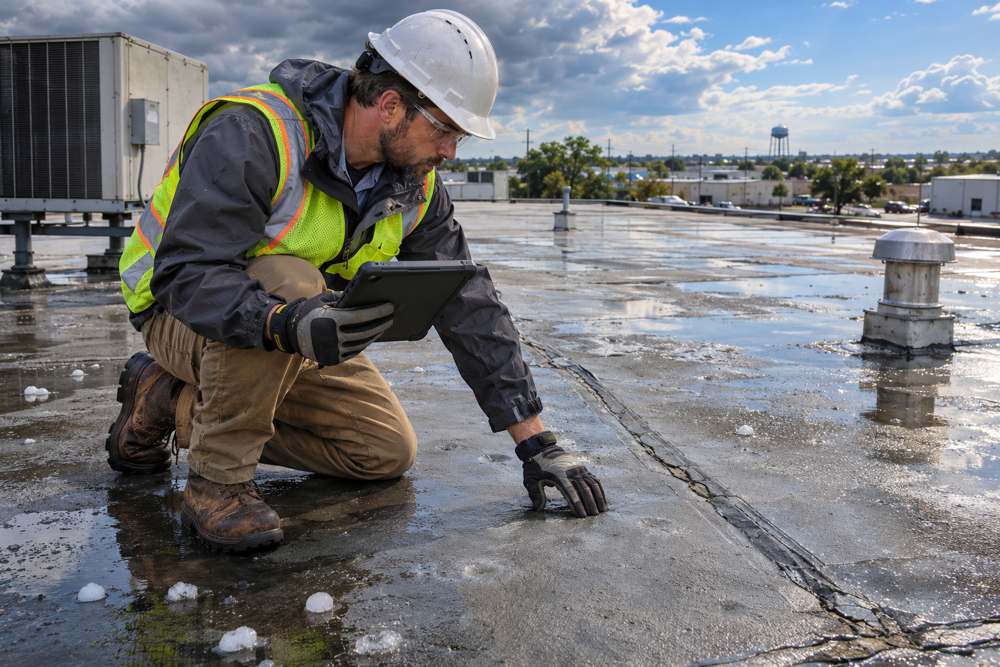
On top of ordinary wear, Garland sits in a part of North Texas that collects severe hail year after year, and the big, flat, exposed roofs on its industrial parks offer plenty of target. Hail seldom tears an obvious hole; more often it bruises the membrane, splits brittle old seams, or batters metal panels, leaving the interior dry while the damage quietly compounds the roof's age. Across a vast roof, scattered hail bruising can add up to a system-wide problem that surfaces as leaks a season later, after the window to file a claim has narrowed. For that reason, a large industrial roof deserves a professional look after any serious storm, not just when water appears inside. Building that post-storm habit into facility management is part of responsible commercial roofing in Garland.

For a Factory, Downtime Is the Real Expense

The cost of a roof leak on a Garland production building is rarely the roof repair itself. It is the stopped line, the damaged machinery, the ruined raw stock, and the shift that cannot run while water drips over the floor. A warehouse full of pallets or a plant full of electronics has far more at risk below the roof than the membrane above it is worth. That changes the calculation on maintenance. Two inspections a year that catch a failing drain or a lifting seam cost a few cents per square foot and prevent the interruption that actually hurts, and a nearby contractor who can respond fast to an active leak limits the damage when one does happen. For facility managers running real operations, that operational stakes view is the most useful frame for commercial roofing in Garland, because the roof is protecting the business, not just the building.

Handling the Insurance Side Carefully

When a major storm rolls through, Garland draws the usual flood of out-of-area crews pitching quick roof claims and vanishing soon after. A settled local contractor treats a storm claim as a documentation job, not a sales sprint. That means photographing and mapping the hail damage across the whole roof, writing a precise scope of what the storm actually harmed, and reviewing the insurer's estimate against that scope so nothing valid is dropped, with someone present when the adjuster inspects. Texas enacted House Bill 3 to set boundaries on how roofing contractors and insurance carriers engage on storm claims, and working within those boundaries protects the property owner. SCR assembles the evidence and argues for an accurate scope alongside the owner's adjuster, while being candid that it serves as a roofing contractor rather than a public adjuster. On a large industrial claim, that careful, rule-abiding conduct is what commercial roofing in Garland should look like.

A Contractor Sized for the Job

SCR, Inc. General Contractors is a family-owned, bonded and insured Texas commercial roofing firm serving Garland and the DFW metroplex, certified by GAF, Carlisle, Firestone, Johns Manville, Versico, Sika Sarnafil, and Mule-Hide to install systems that carry warranties measured in decades, including no-dollar-limit coverage. Its estimators are Xactimate-trained for storm claims, its crews work to the HB3 standard, and it answers around the clock for emergency leaks and post-hail tarping, dispatching to Garland from Terrell and Rockwall. Free inspections come with written reports a facility manager can plan a capital budget around. For commercial roofing in Garland, from a phased replacement on a plant to a coating on a warehouse or a storm claim on a distribution center, contact SCR, Inc. General Contractors at (972) 839-6834 for a free inspection.


Royse City, Texas
Main Street in Royse City
Motto: 
"A Friendly Touch of Texas"
Location of Royse City in Rockwall County, Texas
Coordinates: 32°59′31″N 96°17′50″W / 32.99194°N 96.29722°W / 32.99194; -96.29722
Country United StatesUnited States
State TexasTexas
Counties Rockwall, Collin, Hunt
Government
 
 • Type Council-Manager
 • City Council Mayor
Area
 • Total
18.42 sq mi (47.71 km2)
 • Land 18.29 sq mi (47.38 km2)
 • Water 0.13 sq mi (0.33 km2)
Elevation 522 ft (159 m)
Population
 (2020)
 • Total
13,508
 • Estimate 
(2025)[3]
28,307
 • Density 803.6/sq mi (310.27/km2)
Time zone UTC-6 (CST)
 • Summer (DST) UTC-5 (CDT)
ZIP code
75189
Area codes 214, 469, 903, 945, 972
FIPS code 48-63668[4]
GNIS feature ID 2411012[2]
Website www.roysecity.com

Royse City is a city in Rockwall County in the U.S. state of Texas. It also extends into Collin and Hunt counties. and is also part of the Dallas-Fort Worth Metroplex. The population was 2,957 at the 2000 census, rising to 9,349 in 2010.[5] The estimated population in 2018 was 12,998.[6] In 2020, its population grew to 13,508.[7]

History

[edit | edit source]

Garrett Burgess Griffin Royse, better known as Byrd Royse, was born in Adair County, Kentucky, on January 31, 1838, to William and Mary Stone Royse. He was the seventh of 14 children. Circa 1850, Royse's future grandmother-in-law, Mrs. Nancy McCasland, and her sons bought several tracts of land that were later to become known as Royse City.

Royse was instrumental in getting the Missouri, Kansas and Texas Railway line brought from Greenville to Dallas through Rockwall County. Royse City was settled in 1885, when the railway came through the area. The town was named after G. B. Royse, who plotted the town and sold the first lots.[8]

After its founding, Royse City preserved its stable, small, country-town status due to its proximity to Garland (21 miles away) and Dallas (33 miles).[9]

Interstate 30 was constructed just south of the city in the mid-1960s.[10] The city grew south to meet the interstate.

In 2000, Royse City had a population of 2,957. Still a small town, Royse City was feeling the impacts of the rapid growth of the Dallas-Fort Worth area, along with Rockwall County. The city's location along Interstate 30 between Rockwall and Greenville helped to fuel this growth.

Royse City has grown rapidly to the north and south as newer subdivisions have been built. By 2010, Royse City had a population of 9,349, according to the U.S. Census Bureau. This represents a growth rate of 216.2%.[5]

Geography

[edit | edit source]

Royse City is located in the northeastern corner of Rockwall County, and extends north into Collin County and east into Hunt County. According to the United States Census Bureau, Royse City has a total area of 15.1 square miles (39.2 km2), of which 15.0 square miles (38.9 km2) are land and 0.1 square miles (0.3 km2), or 0.75%, is covered by water.[5]

Demographics

[edit | edit source]
Historical population
Census Pop. Note %±
1890 299   —
1900 503   68.2%
1910 1,210   140.6%
1920 1,289   6.5%
1930 1,128   −12.5%
1940 1,190   5.5%
1950 1,266   6.4%
1960 1,274   0.6%
1970 1,535   20.5%
1980 1,566   2.0%
1990 2,206   40.9%
2000 2,957   34.0%
2010 9,349   216.2%
2020 13,508   44.5%
2025 (est.) 28,307 [3] 109.6%
U.S. Decennial Census[11]

2020 census

[edit | edit source]

As of the 2020 census, Royse City had a population of 13,508, 4,335 households, and 3,711 families residing in the city. The median age was 32.8 years. 30.7% of residents were under the age of 18 and 8.7% of residents were 65 years of age or older. For every 100 females there were 94.8 males, and for every 100 females age 18 and over there were 90.8 males age 18 and over.[12]

90.8% of residents lived in urban areas, while 9.2% lived in rural areas.[13]

Of the 4,335 households in Royse City, 51.2% had children under the age of 18 living in them. Of all households, 62.4% were married-couple households, 11.8% were households with a male householder and no spouse or partner present, and 20.2% were households with a female householder and no spouse or partner present. About 13.5% of all households were made up of individuals and 4.9% had someone living alone who was 65 years of age or older.[12]

There were 4,607 housing units, of which 5.9% were vacant. The homeowner vacancy rate was 2.3% and the rental vacancy rate was 11.3%.[12]

Racial composition as of the 2020 census[14]
Race Number Percent
White 9,205 68.1%
Black or African American 1,145 8.5%
American Indian and Alaska Native 153 1.1%
Asian 226 1.7%
Native Hawaiian and Other Pacific Islander 14 0.1%
Some other race 1,002 7.4%
Two or more races 1,763 13.1%
Hispanic or Latino (of any race) 3,122 23.1%

2000 census

[edit | edit source]

At the 2000 census, the racial makeup of the city was 79.44% White, 7.51% African American, 0.47% Native American, 0.54% Asian, 9.54% from other races, and 2.50% from two or more races. Hispanics or Latinos of any race were 20.97% of the population. At that time, there were 2,957 people, 1,027 households, and 781 families residing in the city.[4]

In 2000, the median income for a household in the city was $42,266, and for a family was $48,804. Men had a median income of $30,966 versus $23,804 for women. The per capita income for the city was $17,153. About 8.4% of families and 10.4% of the population were below the poverty line, including 12.0% of those under age 18 and 10.2% of those age 65 or over.

Economy

[edit | edit source]

Royse City serves as a bedroom community for nearby Dallas and Greenville. Most of the development in the city is residential. The local economy consists of service businesses, restaurants, stores, schools, and medical offices. In June 2019, the popular travel center chain Buc-ee's added a store in Royse City.[15]

In 2007, Royse City was designated as an official Texas Main Street City. The Royse City Main Street program was set up to promote the city's downtown area, where the goals are to foster a thriving business district, while preserving historic buildings.[16] In 2015, construction was completed on an overpass at Interstate 30 and Erby Campbell Blvd.[17]

Education

[edit | edit source]

The entirety of Royse City is served by the Royse City Independent School District. Royse City High School (RCHS) is only high school serving the entirety of Royse City.[18] In the 2024 U.S. News & World Report high school rankings, RCHS ranked #569 in Texas and #183 in the Dallas Metro Area.[19]

Infrastructure

[edit | edit source]

Roads

[edit | edit source]
  • I-30 is the primary route through Royse City.
  • SH 66 (Texas State Highway 66).

Notable people

[edit | edit source]

References

[edit | edit source]
  1. ^ "2019 U.S. Gazetteer Files". United States Census Bureau. Retrieved August 7, 2020.
  2. ^ a b U.S. Geological Survey Geographic Names Information System: Royse City, Texas
  3. ^ a b "City and Town Population Totals: 2020-2025". United States Census Bureau. May 26, 2026. Retrieved July 29, 2026.
  4. ^ a b "U.S. Census website". United States Census Bureau. Retrieved January 31, 2008.
  5. ^ a b c "Geographic Identifiers: 2010 Census Summary File 1 (G001): Royse City city, Texas". U.S. Census Bureau, American Factfinder. Retrieved August 3, 2015.cite web: CS1 maint: deprecated archival service (link)
  6. ^ "Population and Housing Unit Estimates". Retrieved August 16, 2019.
  7. ^ "Explore Census Data". data.census.gov. Retrieved May 21, 2022.
  8. ^ "Royse City, Texas". Texas State Historical Association. Retrieved August 9, 2012.
  9. ^ "Royse City, Texas - A Friendly Touch of Texas". roysecity.com. Archived from the original on October 25, 2012. Retrieved August 8, 2015.
  10. ^ Slotboom, Oscar. "Old Road Maps of Texas, 1942–73". Archived from the original on April 12, 2009.[unreliable source?]
  11. ^ "Census of Population and Housing". Census.gov. Retrieved June 4, 2015.
  12. ^ a b c "2020 Decennial Census Demographic Profile (DP1)". United States Census Bureau. 2021. Retrieved February 13, 2026.
  13. ^ "2020 Decennial Census Demographic and Housing Characteristics (DHC)". United States Census Bureau. 2023. Retrieved February 13, 2026.
  14. ^ "2020 Decennial Census Redistricting Data (Public Law 94-171)". United States Census Bureau. 2021. Retrieved February 13, 2026.
  15. ^ "Buc-ee's announces grand opening date". June 3, 2019.
  16. ^ "Royse City, Texas - Main Street - A Friendly Touch of Texas". roysecity.com. Retrieved August 8, 2015.
  17. ^ "Royse City CDC Official Website". roysecitycdc.org. Retrieved August 8, 2015.
  18. ^ www.rcisd.org https://www.rcisd.org/page/boundary-zones. Retrieved February 25, 2025. cite web: Missing or empty |title= (help)
  19. ^ "RCHS U.S. News & World Report Ranking". U.S. News & World Report. Retrieved February 25, 2025.
  20. ^ "Morgan, Dowell: Hall Nominees 'No Strangers'". Lubbock Avalanche-Journal. October 18, 1963. p. 2D – via Newspapers.com. Open access icon
[edit | edit source]


Frequently Asked Questions

Scale changes everything. On a roof of 100,000 square feet or more, a small per-foot price difference becomes a six-figure decision, and the work is usually phased across sections so operations keep running. A moisture survey first determines whether the whole roof needs replacing or parts can be coated and saved.

Often, if the deck and structure are still sound and moisture has not saturated the insulation. A restoration coating can add ten to fifteen years at a fraction of replacement cost, which is significant on a large roof. An infrared scan and core samples confirm whether the roof qualifies before any decision is made.

Usually far more than the repair itself. A leak can stop a line, damage machinery, and ruin raw materials or inventory, so the loss below the roof dwarfs the membrane above it. That is why fast local response and regular maintenance matter so much for manufacturing and warehouse buildings.