Why Kerrville's Water Is So Hard, and What It's Doing to Your Water Heater
There is a particular surprise that comes with settling into Kerrville. The water starts in one of the prettiest rivers in Texas, the Guadalupe, and yet within a few weeks the glassware looks cloudy, the shower leaves a film on the skin, and the water heater starts to sound older than it is. None of that fits the postcard. The explanation gets clear once the water is traced from source to tap. By the time it reaches the house, Kerrville water is very hard, and that hardness works against the plumbing quietly, every single day.
Where Kerrville's water actually comes from
Kerrville does not pull its water from one place. The city blends surface water from the Guadalupe River with groundwater from Lower Trinity Aquifer wells and from aquifer storage and recovery wells, all managed alongside the Upper Guadalupe River Authority. The river water on its own is clean and well regarded. The groundwater is a different animal. Trinity water moves through limestone and picks up a heavy load of calcium and magnesium along the way, and it tends to be more mineralized than the water under much of Central Texas. There is even a clever twist in how the system works. Through aquifer storage and recovery, Kerrville banks treated water underground during wet stretches and draws it back out when the river runs low. However the blend is managed, the minerals ride along to the tap, which is why water that began as excellent river water still behaves like hard water in a Kerrville kitchen.
Where Kerrville water comes from
Kerrville blends surface water from the Guadalupe River with Lower Trinity Aquifer wells and aquifer storage and recovery wells, managed alongside the Upper Guadalupe River Authority. The river water is clean, but the groundwater adds the hardness homeowners notice.
Very hard by the numbers
Studies of Kerrville's supply place its hardness around 270 to 380 milligrams per liter, roughly 16 to 22 grains per gallon, which sits in the very hard category. Water is considered very hard above about 10 and a half grains per gallon.
Kerrville banks water underground
Through aquifer storage and recovery, Kerrville injects treated water into the Trinity Aquifer during wet periods and pulls it back out during dry ones. It is one way the city stretches a limited Hill Country water supply.
Water hardness is measured in milligrams per liter, which reads the same as parts per million, and also in grains per gallon. Studies of Kerrville's supply have placed the hardness in the range of 270 to 380 milligrams per liter, which sits squarely in the very hard category. In grains per gallon, the unit a water softener actually uses, that is roughly 16 to 22 grains. For context, water is considered very hard above about 10 and a half grains per gallon, so Kerrville often runs at nearly twice that line. The number matters because it holds whether a home is on city water or a private Kerr County well. This is not a bad batch or a seasonal fluke. Very hard water is simply the Kerrville baseline, and every appliance that touches it is affected.
Why your water heater feels it first
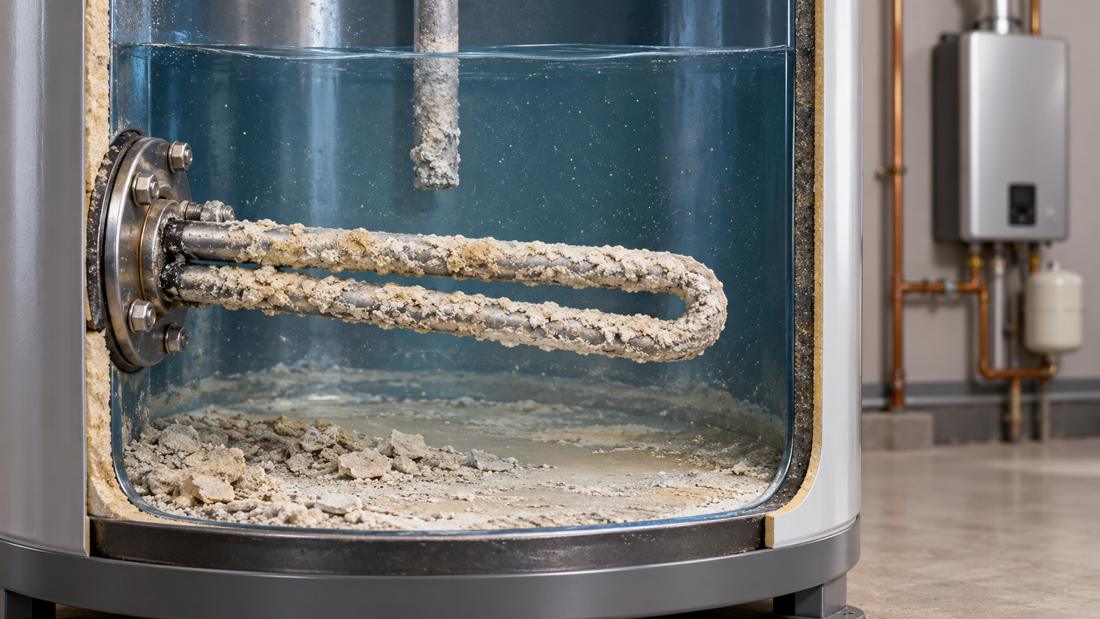
Of everything plumbed into a Kerrville home, the water heater takes the hardest hit, because it runs water hotter and longer than anything else. Heat is exactly what pulls minerals out of hard water. In a standard tank heater, calcium and magnesium settle to the bottom and bake onto the heating element as a chalky scale. That layer acts like insulation, so the burner runs longer and hotter to heat the same water, energy use climbs, and the deposit hardens into a crust. Owners usually hear it before they see it, a popping or rumbling as water tries to boil under the sediment. The crust also accelerates wear on the anode rod and the tank walls, so the heater gives less hot water, costs more to run, and fails years before it should. It is common to meet a Kerrville homeowner who has replaced a water heater twice in under a decade without ever learning that the water was the cause.
Tankless water heaters face the same minerals in a tighter space. A tankless unit heats water on demand by forcing it through a heat exchanger, the hottest surface in the system, and scale builds there fast on hard water. As it does, flow drops, temperatures wander, and the unit starts throwing error codes or shutting down to protect itself. The popular Hill Country brands, Navien, Rinnai, and Rheem, all depend on that heat exchanger staying clean, which is why a tankless heater in Kerrville needs descaling far more often than the once-a-year most manuals suggest, and really wants a softener upstream. Either kind of water heater lasts much longer once the hardness is handled.
The quiet signs before it quits
Hard water rarely announces itself. It shows up in small, easy-to-miss ways first:
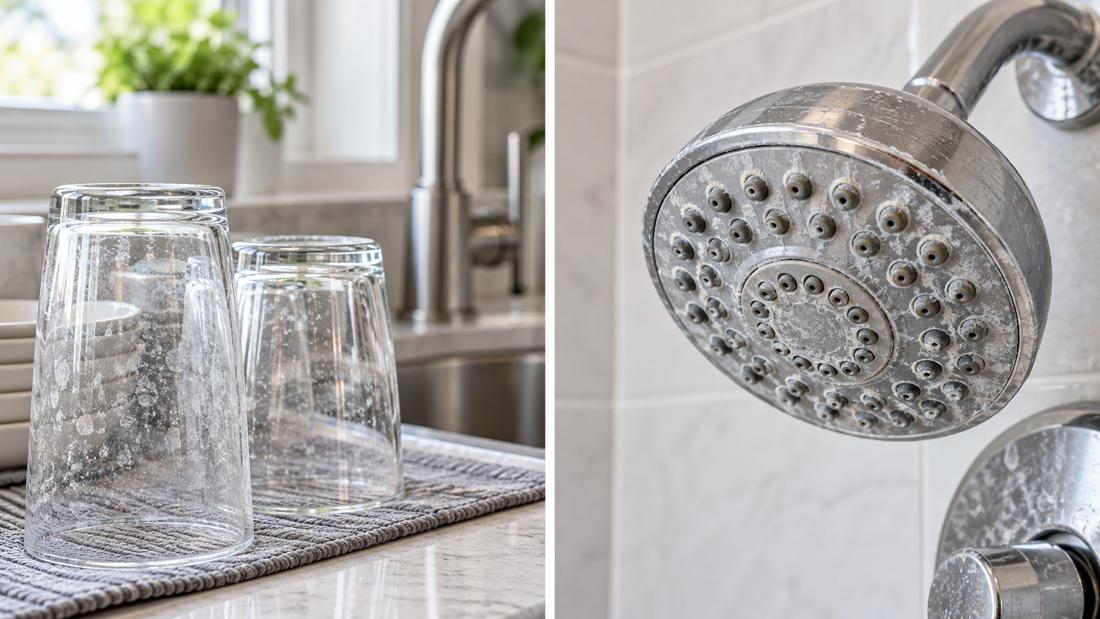
Cloudy glasses and spotty dishes that never quite rinse clean.
A filmy feel on the skin after a shower, and soap that will not lather well.
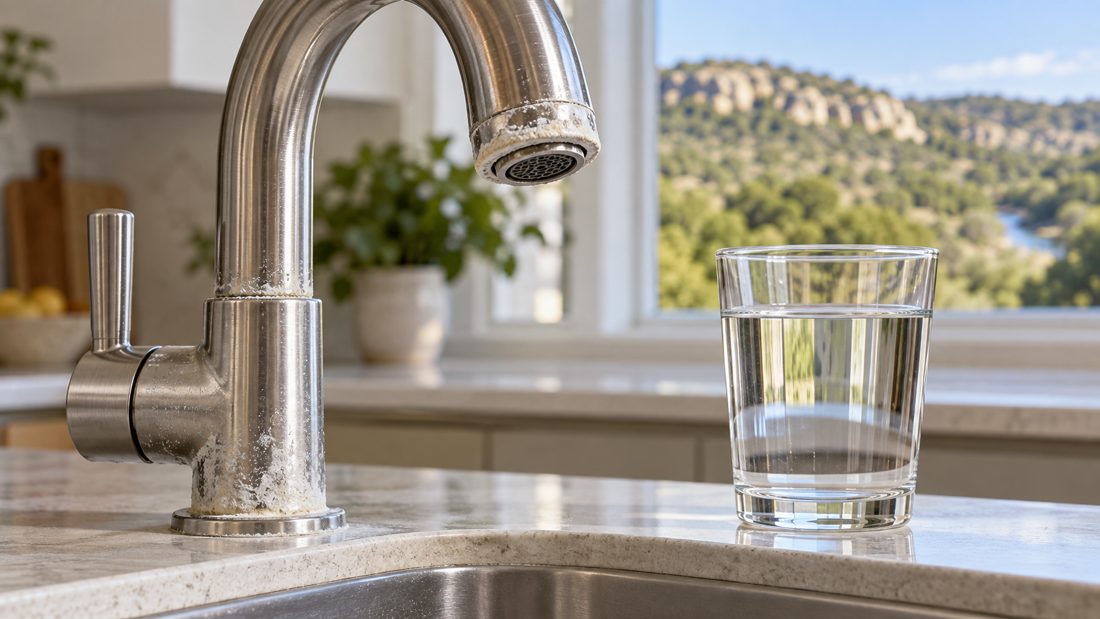
White, crusty scale on faucets, showerheads, and around drains.
Popping or rumbling from the water heater, or hot water that runs out sooner than it used to.
Gas or electric bills creeping up as the heater works harder against the scale.
What hard water does to the rest of the house
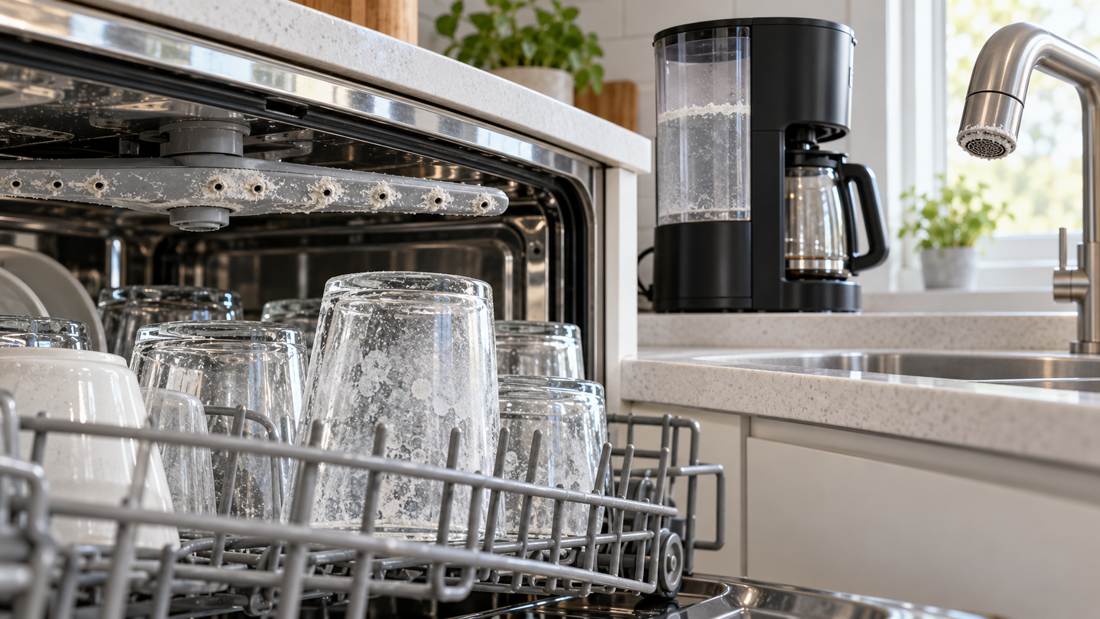
The water heater is the loudest victim, not the only one. The same minerals coat faucet aerators and showerheads, stiffen valves, and leave spots on glass and tile that cleaning never fully removes. Dishwashers, washing machines, coffee makers, and ice makers all wear faster on hard water, and they ask for more soap and detergent to do the same job. Over the years, scale narrows the inside of pipes and collects in fixtures. None of it is dramatic on any single day. The cost adds up quietly, through shorter appliance lifespans, higher utility bills, and a steady trickle of small repairs that all trace back to the same source.
The fix most Kerrville homes land on
The root solution to hard water in Kerrville is a water softener. A softener runs the incoming water through a bed of ion exchange resin that swaps the calcium and magnesium for a small amount of sodium, so the water stops leaving scale behind. Sizing is where it succeeds or fails. Most Kerrville households fit a softener in the 32,000 to 64,000 grain range, chosen from the number of people in the home and the measured hardness, which here runs toward the high end. A salt-based softener actually removes the hardness minerals and gives the strongest protection. A salt-free conditioner changes how the minerals behave rather than removing them, which helps but protects less on water this hard. Many homeowners add a reverse osmosis unit at the kitchen sink for drinking water, since high mineral content can leave a taste a softener alone does not touch. Correct sizing, sensible placement, and a clean install with a proper bypass are what separate a softener that quietly works for a decade from one that becomes a service call, and that protection is also what keeps a water heater's manufacturer warranty intact on scale-related failures. This is the kind of water treatment work Gottfried Plumbing handles across Kerrville and the surrounding Hill Country.
City water or a Kerr County well, both deserve a look
City water and well water both end up hard here, but they are not identical problems. A home on Kerrville city water gets hard but consistent water, and a properly sized softener usually settles it. A home on a private well in the rural parts of Kerr County, out toward Ingram, Hunt, Center Point, or Mountain Home, draws straight from the Trinity aquifer, which tends to be even more mineralized and can carry sediment or iron on top of the hardness. Those wells often need a sediment pre-filter, and sometimes an iron filter, ahead of the softener. The right setup depends on a water test that checks hardness, pH, total dissolved solids, and iron. On a well there is no treatment upstream, so whatever the ground delivers is what the plumbing lives with until it is addressed at the house.
The cost of acting against the cost of waiting
The math favors acting. A whole-house water softener runs roughly 1,500 to 3,500 dollars installed, and a higher-capacity system with iron filtration for a well runs about 2,500 to 5,000 dollars. The install usually takes an afternoon. Set that against the slow bill hard water runs in the background. A water heater that should last a decade can fail in half that time on scale, and each replacement runs well into the thousands. Add the descaling a tankless unit needs, the fixtures that corrode, and the appliances that wear early, and a softener often pays for itself the first time it heads off a failure. Treating the water once protects the heater, the pipes, the fixtures, and the appliances all at the same time, which is a far better position than replacing them one expensive surprise at a time.
Where Kerrville homeowners turn
For a Kerrville home fighting hard water, the answer is rarely one gadget. It is a water test, the right treatment for what the test shows, and the water heater work that hard water keeps creating. Gottfried Plumbing LLC covers that full range from its Boerne shop at 607 E Blanco Road, running northwest up Interstate 10 to serve Kerrville and Kerr County, including Ingram, Hunt, Center Point, and Comfort. The work spans water testing, water softener and filtration installation, iron and sediment filtration for wells, and water heater repair, replacement, and tankless service across Navien, Rinnai, Rheem, and the major tank brands. As a Texas State Board of Plumbing Examiners licensed contractor on a 24 hour a day, 7 day a week schedule, it handles both emergencies and planned treatment work. Kerrville homeowners ready to get ahead of hard water can call (830) 331-2055 for a free estimate.
About Kerrville
"Kerrville" redirects here. For the community in Missouri, see Kerrville, Missouri.
Being nestled in the hills of the Texas Hill Country, Kerrville is best known for its parks that line the Guadalupe River, which runs directly through the city; its other features include nearby youth summer camps, hunting ranches, and RV parks. It is home to the Texas' Official State Arts and Crafts Fair, the Kerrville Folk Festival, the Kerrville Triathlon (since 2011), and the Kerrville Renaissance Festival (since 2017), as well as Mooney Aviation Company,[5]James Avery Jewelry, and Schreiner University. The Museum of Western Art (founded 1983) features the work of living artists specializing in the themes of the American West.
Early white settlers included successful shinglemakers whose mercantile business became a hub that served the middle and upper Hill Country area in the late 1840s. One of the earliest shinglemakers was Joshua D. Brown. With his family, Brown had led several other families on an exploration of the Guadalupe Valley. These early pioneers organized their settlements near a bluff just north of the Guadalupe River in the eastern half of the future county location. The settlement was referred to as "Brownsborough", but after the area was formally platted in 1856 by James Kerr, a major in the Texas Revolution, the settlement was formally known as "Kerrville" and maintained a county seat with Texas.
Starting in 1857, a German master miller named Christian Dietert and millwright Balthasar Lich started a large grist- and sawmill on the bluff. This mill established a permanent source of power and protection from floods, and became the most extensive operation of its kind in the Hill Country area west of New Braunfels and San Antonio. Soon afterwards, Charles A. Schreiner rode Kerrville's newly found popularity by serving Kerrville's mercantile needs. Schreiner established a family-run empire that helped build Kerrville's early prosperity by owning almost all of Kerrville's business sectors, including freighting enterprises, retail, wholesale, banking, ranching, marketing, and brokering operations. Schreiner's elegant downtown home, a Romanesque stone structure at 226 Earl Garrett Street, is the site of the Hill Country Museum in downtown Kerrville.
The Civil War slowed Kerrville's development, but with the start of the Reconstruction era, Kerrville's economic boom and ethnic diversification continued anew as demand grew in San Antonio for lumber, produce, and craftsmen. Kerrville's boom was also catalyzed by the combination of the cessation of Indian raids and the expansion into the business of cattle, sheep, and goat ranching. Cattle drives punctuated the boom years of the late 1880s and the 1890s. In 1887, the San Antonio and Aransas Pass Railway reached Kerrville, and in 1889, the town incorporated, with an aldermanic form of city government.
The Kerrville Water Works Company began to provide water for town dwellers in 1894. Telephone service was introduced in 1896, and the city began to pave streets in 1912. Kerrville adopted a "commission" form of city government in 1917, then changed to the "city-manager" form in 1928. In 1942, the town adopted a home-rule charter, while continuing with a city manager. Kerrville has displayed steady population growth throughout the 20th century, increasing from 1,423 residents in 1900 to 2,353 in 1920, 5,572 in 1940, 8,901 in 1960, and 15,276 in 1980. Its economic base has diversified and broadened through business, agriculture, light manufacturing, health care, transportation, services, education, the arts, and tourism. By the mid-1990s, the Wall Street Journal described Kerrville as one of the wealthiest small towns in America. By 1995, the city's official population was still under 18,000, with another 20,000 people in relatively affluent residential areas south of the river and the rest of the county. In 2000, its population reached 20,425. Much of the growth included retirees and young professionals and semiprofessionals; for many years, Kerrville also experienced significant emigration of young adults raised in the area.
Kerrville is located in eastern Kerr County. Via I-10, it is 65 miles (105 km) northwest of San Antonio and 52 miles (84 km) southeast of Junction. SH 16 is the main road through the center of Kerrville. SH 16 leads northeast 24 miles (39 km) to Fredericksburg and southwest the same distance to Medina. SH 173 leads south 25 miles (40 km) to Bandera, while SH 27 leads west 6 miles (10 km) to Ingram and east 18 miles (29 km) to Comfort.
According to the United States Census Bureau, Kerrville has a total area of 20.7 square miles (53.7 km2), of which 20.3 square miles (52.6 km2) are land and 0.42 square miles (1.1 km2) (2.00%) is covered by water.[8] The Guadalupe River runs through the city, with the downtown area sitting on the northeastern side.
As of the 2020 census, Kerrville had a population of 24,278. The median age was 48.4 years; 17.2% of residents were under 18 and 30.6% were 65 or older. For every 100 females, there were 90.1 males, and for every 100 females 18 and over, there were 87.3 males 18 and over.[13][14]
Almost all of the residents lived in urban areas, while only 2.5% lived in rural areas.[15]
Of the 10,392 households in Kerrville, 21.9% had children under 18 living in them, 41.5% were married-couple households, 18.9% were households with a male householder and no spouse or partner present, and 33.9% were households with a female householder and no spouse or partner present. About 36.4% of all households were made up of individuals, and 21.3% had someone living alone who was 65 or older.[13]
The city had 11,439 housing units, of which 9.2% were vacant. The homeowner vacancy rate was 2.0% and the rental vacancy rate was 7.7%.[13]
As of the census of 2000,[16] 20,425 people, 8,563 households, and 5,411 families resided in the city. The population density was 1,222.5 inhabitants per square mile (472.0/km2). The 9,477 housing units averaged 567.2 per square mile (219.0/km2). The racial makeup of the city was 85.89% White, 2.99% African American, 0.55% Native American, 0.57% Asian, 0.08% Pacific Islander, 8.20% from other races, and 1.73% from two or more races. Hispanics or Latinos of any race were 22.73% of the population.
Of the 8,563 households, 8.9% had children under 18 living with them, 49.8% were married couples living together, 10.2% had a female householder with no husband present, and 36.8% were not families. About 33.1% of all households were made up of individuals, and 19.4% had someone living alone who was 65 or older. The average household size was 2.21, and the average family size was 2.79.
In the city, the population was distributed as 21.0% under 18, 8.0% from 18 to 24, 21.3% from 25 to 44, 20.4% from 45 to 64, and 29.3% who were 65 or older. The median age was 45 years. For every 100 females, there were 87 males. For every 100 females 18 and over, there were 83.0 males.[17]
The median income for a household in the city was $32,085 and for a family was $38,979. Males had a median income of $27,555 versus $19,923 for females. The per capita income for the city was $20,193. About 11.7% of families and 15.6% of the population were below the poverty line, including 25.8% of those under 18 and 7.8% of those 65 or over.[17]
The Kerrville Folk Festival is an annual summer festival, which features folk musicians.[18] Kerrville is home to the annual Texas State Arts and Crafts Fair, which features artisans and entertainers.[19] The Texas Lions Camp and Echo Hill Ranch Summer Camp are also located in Kerrville.
Kerrville hosted the Olympic trials for shooting sports for the 2012 Summer Olympics at the Hill Country Shooting Center.[20]
On Saturday, October 15, 2023, Kerrville experienced a annular solar eclipse of the sun.[21] Six months later, on Monday, April 8, 2024, the Kerrville Eclipse Festival celebrated the annular solar eclipse of the sun.[22]
Kerrville is served by the Kerrville Independent School District, which maintains four elementary schools (Tally, Nimitz, Starkey, and Daniels), one middle school (Peterson), and two high schools (Hill Country High School and Kerrville (TX) Tivy).[23]Our Lady of the Hills Catholic High School[24] and Notre Dame Catholic School[25] and Grace Academy of Kerrville[26] are also located in Kerrville, serving as the primary alternative to the public school system.
Kerrville is home to Schreiner University, a private, four-year university that was established in 1923 by an ex-Texas Ranger, Captain Charles Schreiner.
Until 2020, Schreiner University was also home to Greystone Preparatory School. Greystone offered a one-year preparatory course to help individuals prepare for an appointment to one of the five federal service academies.[27] Since the departure of Greystone, Schreiner Institute was created to fill this role.[28] Directed by a staff of former military officers, the program has since been designated as one of six West Point-approved associate of Graduates Scholarship Programs.[29]
The TaxExemptWorld.com website, which compiles Internal Revenue Service data, reported that in 2013, 465 distinct, active, tax-exempt/nonprofit organizations were in Kerrville, excluding credit unions, had a total income of $414 million and assets of $959 million.[30] One example of a performing arts nonprofit organization in Kerrville would be Art 2 Heart. Seventy-three churches are in or near Kerrville.
Schreiner's Department Store, the mainstay of downtown Kerrville
The Arcadia Theatre at 717 Water St. in Kerrville was built in Spanish style in 1926 and renovated as Art Deco in 1948. It closed in 1989 and remained so until it was renovated once again in 2019.
Francisco's Restaurant at 201 Earl Garrett St., intersecting Water Street, in the Kerrville downtown square
Butt-Holdsworth Memorial Library at 505 Water St. in Kerrville
^Stoutamire, Steve; Wilson, Francoise; McBride, Mike (2019). "41KR754, A NEW PALEOINDIAN AND DIVERSE MULTI-COMPONENTSITE, KERR COUNTY, TEXAS". Ancient Echoes. 8: 31.
Yes, very hard. Kerrville blends Guadalupe River water with Trinity Aquifer and aquifer storage wells, and tests put the hardness around 270 to 380 milligrams per liter, roughly 16 to 22 grains per gallon. That is well into the very hard range, and it applies whether a home is on city water or a Kerr County well.
Do I need a water softener in Kerrville?
For most Kerrville homes, a softener is the practical fix, because water this hard scales water heaters, stains fixtures, and shortens appliance life. A standard whole-house softener runs about 1,500 to 3,500 dollars installed, sized to the household and the measured hardness. Well properties around Ingram or Hunt may also need sediment or iron filtration ahead of it.
Why do water heaters fail early in Kerrville?
Hard water is usually the reason. Minerals bake onto the bottom and element of a tank heater or coat the heat exchanger of a tankless unit, which drives up energy use and wears the unit out years early. A properly sized softener, plus regular descaling for tankless units, is what keeps a water heater running its full life in Kerrville.