
Under Chapter 541 of the Connecticut General Statutes, the New Haven fire marshal is required to inspect buildings and occupancies regulated by the Connecticut State Fire Safety Code, and the inspection interval is fixed by your occupancy type, not by you. Under the 2022 Connecticut State Fire Safety Code, some occupancies are inspected every year while others fall on a two, three, or four year cycle. Your building's classification decides when the inspector arrives.
Connecticut fire safety inspections check more than whether your fire alarm sounds. Fire alarm systems must be inspected and tested annually under NFPA 72, and the records of that testing must be available for the fire marshal to review. A working system with missing or expired documentation can still generate a violation, which is why many properties fail not on broken equipment but on lapsed paperwork.
Failing a New Haven fire marshal inspection rarely means immediate closure. It typically starts with citations and an order to correct the violations within a set window, often around 30 days for minor issues and less time for serious hazards. The pressure is the deadline. A property that cannot get its fire alarm system diagnosed, repaired, and re-tested inside that window risks falling out of compliance before the clock runs out.
A New Haven fire marshal audit is rarely a surprise to the calendar, but the findings often are. Most commercial and multi-family property owners know an inspection is coming, yet they discover the gaps in their fire alarm system only when an inspector is standing in the mechanical room with a clipboard. The local fire marshal is required to inspect buildings and occupancies regulated by the Connecticut State Fire Safety Code, and the fire alarm system sits at the center of that review. Working with a New Haven fire alarm company before the inspector arrives, rather than after a violation notice, is the difference between a routine sign-off and a scramble to correct findings inside a 30 day window. Mammoth Security works on the front end of that cycle, designing, installing, inspecting, and monitoring fire alarm systems across New Haven so the audit becomes a formality instead of a fire drill.

The New Haven Office of the Fire Marshal, based at 952 Grand Avenue, carries duties imposed by Chapter 541 of the Connecticut General Statutes. The marshal inspects buildings and facilities of public use and the occupancies regulated by the Connecticut State Fire Safety Code, and the stated goal of every inspection is the safe egress of occupants who could be endangered by a fire or its products. That framing matters, because it tells you what an inspector is actually looking for. The audit is not a hunt for paperwork errors. It is a check on whether, at the moment an emergency starts, the building will detect the fire, notify the people inside, and let them get out.
For a fire alarm system specifically, the audit examines whether the system is installed and maintained to the standard the code references, whether it has been inspected and tested on the required cycle, whether records of that testing are available for review, and whether the notification appliances and detection devices function as designed. A thorough integrator treats those four items as the spine of any pre-audit preparation, because they are the items most likely to generate a finding. When a system fails an audit, it is usually not because the building lacks a fire alarm. It is because a component drifted out of compliance quietly: a detector past its sensitivity window, a notification appliance that no longer sounds at the required level, a battery backup at end of life, or a testing record that was never filed.
Fire alarm systems in Connecticut commercial and multi-family occupancies are inspected and tested annually, with NFPA 72, the National Fire Alarm and Signaling Code, serving as the governing industry standard for how that testing is performed and documented. The records of that inspection must be available for the fire marshal to review. This is the single most common point where property owners stumble, because the testing cycle runs on its own clock regardless of when the marshal happens to schedule the property audit. A building can pass a marshal inspection in one year and fail the next, not because anything broke, but because the annual fire alarm inspection lapsed and the documentation went stale.
This is why an integrator that handles both installation and ongoing inspection is worth more than one that only installs. Mammoth Security designs and installs conventional and addressable fire alarm systems and then keeps them on the inspection cycle that the code requires, which means the testing records exist and are current when the marshal asks for them. A conventional panel groups devices into zones, telling responders a fire is somewhere in a given area, while an addressable panel identifies the exact device that activated, which speeds both emergency response and routine troubleshooting. Either type has to be tested and documented on schedule, and a provider that owns that calendar removes the most predictable cause of an audit failure.
An inspector walking a New Haven property will look at the detection and notification devices that make up the system. On the detection side, that means smoke detectors, heat detectors, and in some occupancies flame detectors and duct detectors, each placed and rated for the environment it serves. A duct detector, which is the smoke sensor mounted in a building's air handling ductwork to shut down the HVAC system and stop smoke from spreading through the building, is a frequent point of attention because it ties the fire alarm system to the mechanical system. On the notification side, the inspector checks horn strobe notification appliances, the devices that combine an audible horn with a visual strobe so an alarm reaches occupants who cannot hear it, and in larger or higher-occupancy buildings, voice evacuation systems that deliver spoken emergency instructions rather than a generic tone.
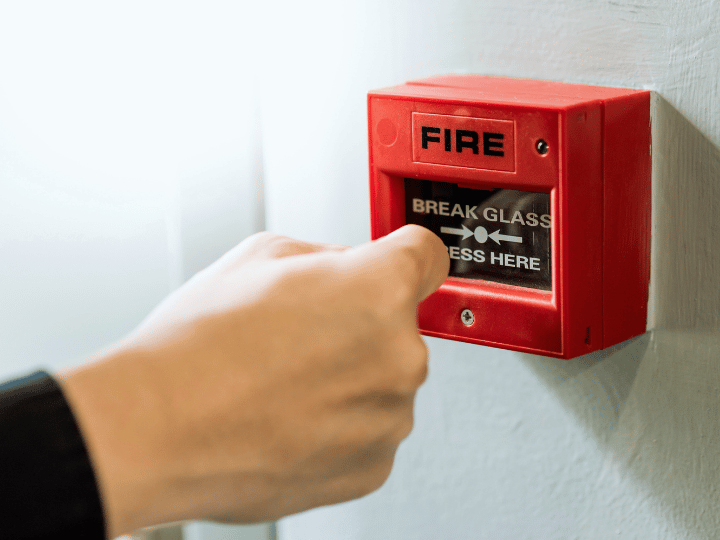
Manual pull stations, the fire alarm control panel itself, and the battery backups that keep the system alive during a power loss all fall under the same review. A capable integrator preparing a property for audit confirms each of these functions before the marshal does, using equipment from established fire manufacturers. Mammoth Security works with Potter, Kidde, Honeywell, and Simplex fire equipment, selecting the panel and devices that fit the building's occupancy and layout rather than forcing one product line onto every site. The point of a pre-audit check is simple: every device the inspector will test should already have been tested by the people who installed and maintain it.

An audit that finds problems does not usually end in an immediate shutdown. In New Haven, a failed or incomplete inspection typically begins with citations and an order to correct the violations within a specified timeframe, often around 30 days for minor issues and a shorter window for serious hazards. That correction window is both a relief and a trap. It is a relief because it gives the property owner time to fix the finding rather than facing instant consequences. It is a trap because the clock is real, and a property that cannot get a fire alarm company to respond, diagnose, source parts, and re-test inside that window can find itself out of compliance with a deadline bearing down.
The way the right partner earns its value here is responsiveness and documentation. Mammoth Security handles the permitting and inspection coordination on the systems it installs, which means when a correction is required, the company already knows the system, already has the as-built documentation, and can move directly to the fix rather than spending the first week of a 30 day window simply learning how the existing system was wired. A fire alarm system is only as defensible at audit as the records and support behind it, which is the same lesson that applies across every system Mammoth installs.
Fire is rarely the only system in a New Haven commercial or multi-family building, and the way the fire alarm system connects to the other systems can either simplify or complicate an audit. The clearest example is the relationship between fire alarm and access control. In a building with electronically controlled doors, the fire alarm system must be able to release those doors on activation so occupants are never trapped behind a locked maglock during an evacuation. A magnetic lock, the electromagnet that holds a door secured under normal operation, has to drop the moment the fire alarm signals, and an inspector focused on safe egress will care a great deal about that link. When the fire alarm company and the access control company are two different vendors, that integration point becomes a place where each blames the other.
This is where the integrated model matters. Mammoth Security is built around one expert team and no vendor juggling, installing cameras, access control, fire alarms, burglar alarms, and the structured cabling that connects them as one documented system supported by one team with one number to call. For a property owner facing a fire marshal audit, that means the company that knows the fire alarm system is the same company that knows how it ties into the access-controlled doors, the same company that documented the whole installation, and the same number to call when the marshal asks a question that crosses two systems. A fire alarm company serving New Haven properties that operates in isolation cannot speak to that integration with the same authority.

New Haven's building stock leans heavily toward exactly the occupancies the fire marshal watches most closely: multi-family apartment properties, mixed commercial buildings, educational facilities near the Yale University and Southern Connecticut State University campuses, and the retail and office spaces around the New Haven Green and Long Wharf. A multi-family property carries some of the most demanding fire alarm obligations of any occupancy, because a finding does not affect one business owner, it affects every tenant in the building. For a property manager running an apartment complex, a fire alarm company that keeps the system audit-ready year round is not a convenience, it is a condition of keeping the building occupied.
The same logic extends across the verticals Mammoth Security serves throughout the New Haven area, from retail and small business to industrial and manufacturing, education, office and medical, and government facilities. Each occupancy type carries its own inspection emphasis, and a security integrator that has worked across those verticals understands what a given inspector will scrutinize in a warehouse versus a medical office versus an apartment building. That experience is what turns a property audit from an unknown into a predictable event.
Mammoth Security operates from four Connecticut locations: New Haven on Whalley Avenue, Bantam in Litchfield County, Norwalk in Fairfield County, and New Britain near the Hartford corridor. From the New Haven location, the team serves the surrounding communities of West Haven, East Haven, North Haven, Hamden, Orange, Woodbridge, Ansonia, and Shelton, along with Branford, Milford, Derby, Seymour, and the rest of the greater New Haven market. That local footprint means the fire alarm company preparing a property for audit already knows the New Haven Office of the Fire Marshal, the rhythm of its inspection cycle, and the way the Connecticut State Fire Safety Code is applied on the ground in this specific market.
Statewide coverage from four locations also means a property owner with buildings in more than one Connecticut market can keep a single fire alarm company across all of them, with consistent documentation and one relationship rather than a different vendor in every town. For a multi-site operator, that consistency is itself an audit advantage, because every building is maintained to the same standard by the same team. A New Haven fire alarm company that can extend the same service to a sister property in Norwalk or New Britain removes the patchwork of vendors that so often produces inconsistent inspection results.
Walking into a fire marshal audit prepared is a matter of having the right fire alarm company behind the system long before the inspector schedules the visit. Mammoth Security is a Connecticut licensed security and low-voltage contractor serving New Haven and the statewide market from four locations, with one expert team handling fire alarms alongside cameras, access control, burglar alarms, and structured cabling. The company designs and installs conventional and addressable fire alarm systems to meet NFPA standards and the requirements of the Connecticut State Fire Safety Code, using Potter, Kidde, Honeywell, and Simplex equipment, handles the permitting and inspection coordination, keeps systems on the required annual inspection cycle so the documentation is current when the marshal asks, and backs every system with 24/7 central station monitoring that notifies the fire department the moment a device activates, even when the building is empty. Rated 4.7 stars by Connecticut clients, Mammoth Security gives New Haven property owners a single fire alarm company to call before the audit, not after the violation. To schedule a free security assessment or a pre-audit review of your fire alarm system, call Mammoth Security at (203) 747-8244.
Redirect to:
|
This page is a redirect. The following categories are used to track and monitor this redirect:
|